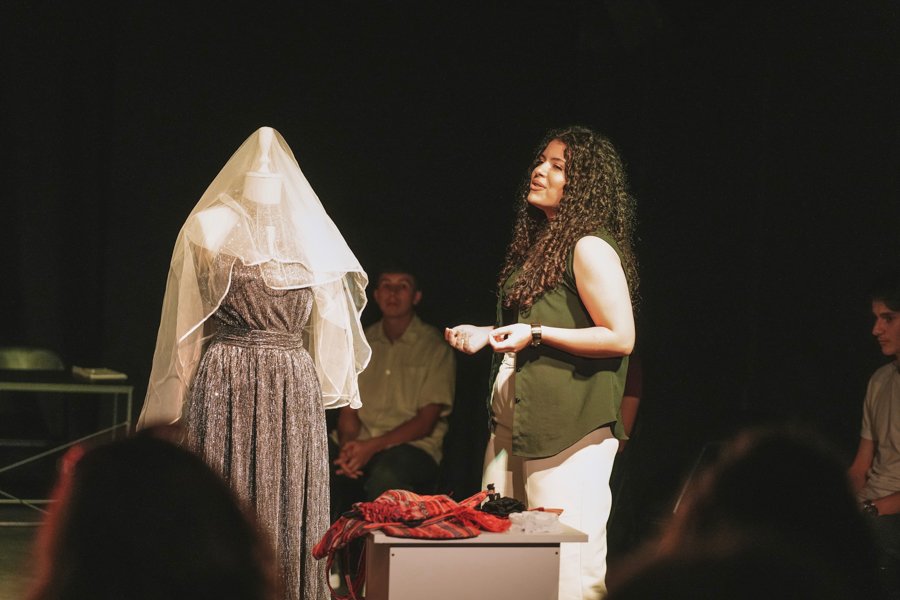
“Our Stories, Our Stage” brought dialogue to Barabar Centre, Prishtina
July 16, 2026
July 16, 2026
July 14, 2026
June 8, 2026
May 25, 2026

August 24, 2026
August 10, 2026
August 9, 2026
September 27, 2024

March 22, 2023
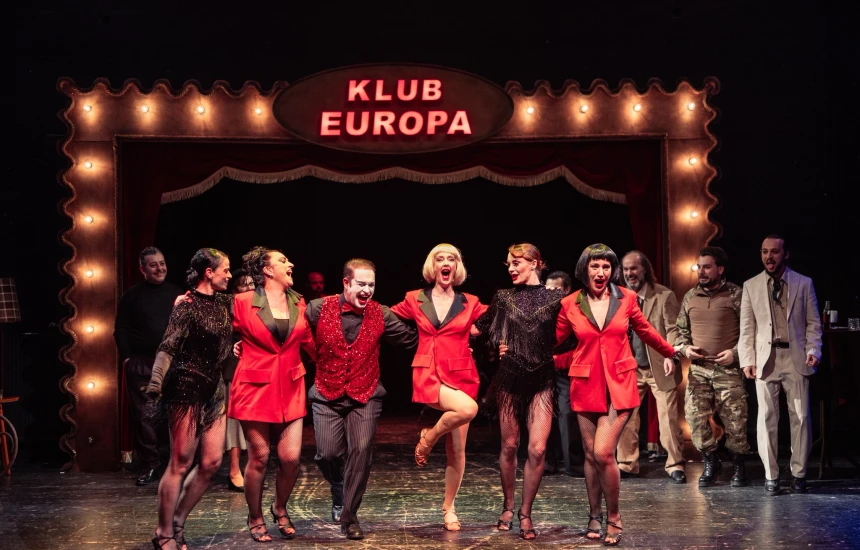
Director Zana Hoxha, based on the play “Cabaret” by Joe Masteroff, shifts the story from 1930s Berlin to Prishtina in 1999 a city just out of the war filled with adrenaline of newfound freedom, lost in the burnt smell of houses, the missing people and the flourishing of a ‘survival-of-the-strongest’ trade. “Kabare 1999” it is a creation of the post-war Kosovo that is still in search of learning to live
“Willkommen, bienvenue, welcome…”, it is a call that opens the world of “Kabare 1999”, a call that sounds like a promise of celebration but the longer the performance lasts the more it turns into a bitter irony. On the evening of February 5, 2026, at the city theatre of Gjilan, this cabaret was appeared as a space divided in between two worlds: between the desire to love and the trade with people’s wounds, between newfound freedom and the fear of a system that devours anyone who dares to live freely.
Director Zana Hoxha, based on the play “Cabaret” by Joe Masteroff, shifts the story from 1930s Berlin to Prishtina in 99 a city just out of the war filled with adrenaline of newfound freedom lost in the burnt smell of houses, the missing people and the flourishing of a ‘survival-of-the-strongest’ trade. Kabare 99 it is a creation of the post-war Kosovo that still is in search of learning to live
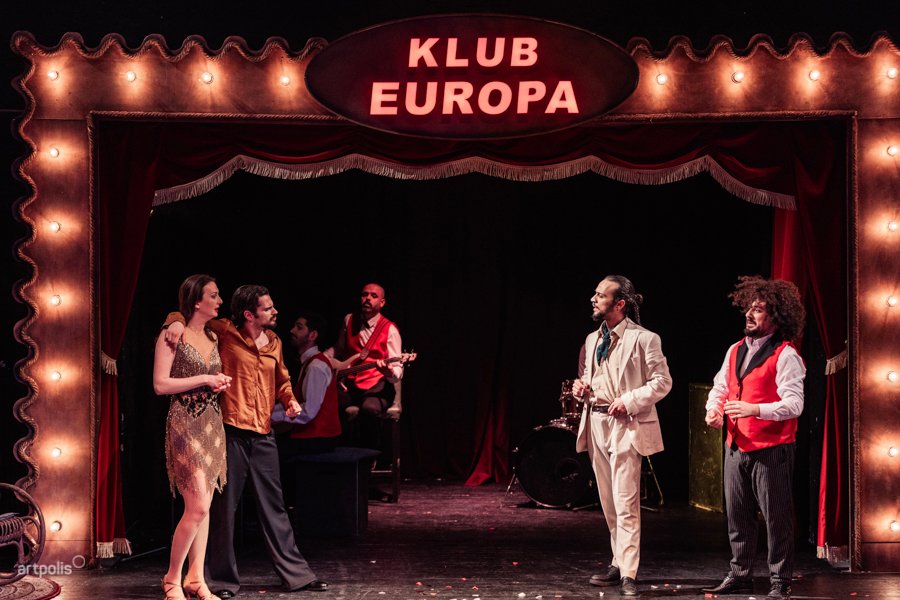
“Europe Club” is the bubble of happiness, of a world without worries, “total” freedom in lighting stars and the magic of endless music. Where life is fun and full of colors.
Post-war in search of learning to live
Zana Hoxha’s directorial choices bring to life ordinary characters at first glance, but everyone complements each other, each has their own uniqueness, events, struggles, and ways of perceiving life. Each is complex, at the same time. A creation of post-war Kosovo that is still in search of learning to live.
The characters repress the post-war gloom of everyday life and live amidst love, sex and pleasure in Prishtina that embraces the individuality of those who dare, even though they are hit hard by the struggle for survival.
“Kabare 1999” breaks the fourth wall, the audience is not only a witness to the events, he is part of it with laughter and dancing. The characters are fused with the audience, moments coexist even among them. Moments that flow naturally and scenes that make you lose track of time. The flow of the play is organic, unforced – from the play of the actors, ballerinas, musicians, to the costumes and scenography.
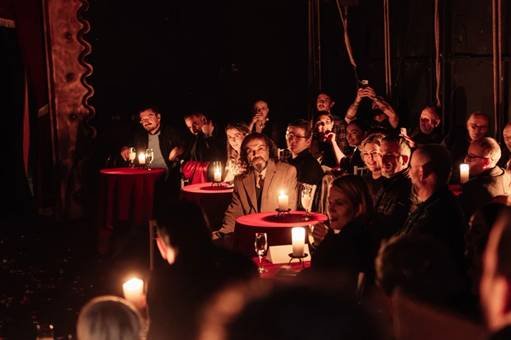
“Kabare 1999” brings us the post-war Kosovo not as frozen heroism, but as a living, disordered life, but still not fully surrendered (Photo: Rilind Beqa)
A moment that advances the local theater
University professor and director, Fadil Hysaj, says that this is the real theater and “Kabare 1999″ advances Kosovar theater.”
“Good performances have no moment, they flow scene after scene. You also feel comfortable in a good sense, culturally, but at the same time you see that the actors are from the beginning all the time a part of a concept, in this case that Zana had, and every artist present there, from the ballerinas, the composer, the actors, everyone is free. It has a magical flow and there is space to say what you feel and say it in the best possible way. The performance is alive. Nobody, none of the actors, will say it now: ‘I will show you what I can do.’ But they play it within a concept. This is a moment that advances our theater”, said Hysaj after the premiere of the performance. “This is the real theater when the choir dances, the choir sings, creates a character, expresses an opinion, but at the same time all together become part of a concept, and that concept is absorbed by the audience, emotionally embracing by the end of the performance, the audience returns the energy to the artists through applause and making it something they won’t easily forget.”
“They forget the burned houses. Missing people…”
At the center of the play is Aida, who sees the city through the eyes of someone who wants to believe, live freely, and dream. She tries to keep an aesthetic distance. But the distance is broken by poverty, by the need for work, by the attraction to Son, by the confrontation with Claudio, by the threat of the MC and the collaboration with Ernest. She says: “I like this city. It is vulgar. Cluttered. Noisy. And everyone behaves as if with the arrival of freedom, all problems are gone.”
In this sentence there is an admiration and an anxiety at the same time. Because immediately after it comes the memory: “But they forget. They forget the burned houses. Missing persons. Devastated families.”
This is the real drama of the show. Not the war – but what happens after it. The moment when people want to live, sing, love, earn money, and build a normality, while a part of them is still looking for the dead.
At the center of the morality of the show is Shyretja, the mother who is looking for her missing son, Fatbardhi. She is not only a tragic figure; she is an ontological figure. “When he disappeared, his name became irony: fate was no longer white, but vague, cut in the middle. Torn from the war”.
However, Shyretja did not accept the disappearance as an end, she continued to seek information. And this story starts there: in her decision not to give up the search — “because some stories exist to prove that the end has not yet been decided.”
Freedom is not forgetting
In this never-ending act of search, the show finds one of the deepest meanings of freedom. Freedom is not just about living. Freedom is not to forget. It’s about not accepting false closures.
But in front of this lies another world – that of the cabaret, which is more than a bar. It is a system. A pace. A way to forget. MC defines this philosophy with brutality when he sings: “Money makes the world go around.” And suddenly, everything becomes an asset – love, body, dream, hope. Russian, Japanese, French, American girls are for sale… and then “young and untouched” Kosovars.
“People have not disappeared only from bullets. They have also disappeared from the deals. […] With information. With false hope. Someone has traded with the fate of the missing. “Silence”. These words of Soni, addressed to Ernest, are an open accusation. Ernest (and MC) become the personification of a brutal form of post-war capitalism – traders of open wounds who buy and sell silence, hope, and time.
In this world, freedom is no longer a given. It becomes something that must be negotiated every day. This is clearly shown in the confrontation between Aida and the MC, when he calmly tells her: “You only have comfort here when someone allows you.”
And then, as an unwritten law of the new reality: “Human? You become a human being… only when they allow you.”
It is here that the play raises questions: what value does freedom have if dignity depends on someone else’s permission? And what does it mean to remain human in a country where everything can be bought?
But “Kabare 1999” is not only chaos. Inside it there is a strong desire to live. It appears in small, unexpected, sometimes fragile ways, but with humor and full of love. In the late love between Afërditës and Agimit, which seems almost naïve, but which is a silent act of resistance to loneliness. In Dudije’s complicated relationship with foreign soldiers, where survival and gratitude are mixed in an unclear moral zone. In Aida herself, who continues to write even when she realizes that her story is no longer just for the disappeared, but for those who benefit from their missing? These are not heroic stories. They are an effort to live. To love. Not to fade away.
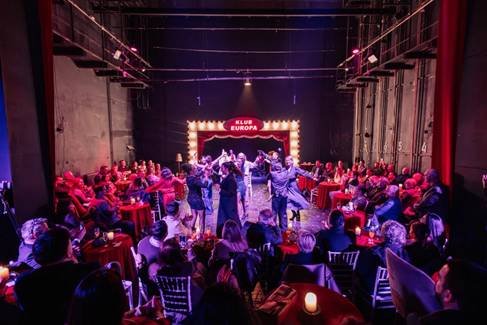
The characters repress the gloom of post-war everyday life and live amidst love, sex and pleasure in Prishtina that embraces the individuality of those who dare, even though they have been hit hard by the struggle for survival (Photo: Rilind Beqa)
A life that does not surrender fully
For actress Semira Latifi, who plays Aida, the cabaret format has made the process of creating the character easier, as she believes that the show will have a long lifespan.
“I can say that this has helped us a lot (the cabaret format), it has made it much easier for us to build a character, it has complemented the character a lot, like my character and all the other characters who have scenes together, have stories together. It is a good form of acting where each actor can show his talent in the best possible form in front of the audience and tonight the audience received it very well, the reactions were very positive and I think that it is a project that will have a long life and a very strong audience within itself”, she said.
Meanwhile, actress Aurita Agushi has said that the adventure of this production has already begun.
“I’m overjoyed (with the audience’s reactions) because the actor on stage feels the energy of the audience. You can also feel its breathing, you can also feel the energy. I know that our adventure has just started and it will be very beautiful with all those who will come to see this spectacle together”, said Agushi, who plays the role of Mrs. Aferdita.
In the end, the show doesn’t offer an answer. It does not heal the wound. It doesn’t save anyone completely. But it leaves us with a strong feeling: that life, even when it is messy, even when it is polluted, continues to seek happiness.
“Kabare 1999” brings us post-war Kosovo not as frozen heroism, but as a living, disordered life, but still not fully surrendered.
“Welcome to the cabaret. And don’t forget – the lights go out when we decide.”
August 24, 2026
InitiativesFor over twenty years, we’ve believed in the power of art to change lives. We've used theater to educate thousands of young people. We've brought the FemArt Festival to life…
Read More
August 10, 2026
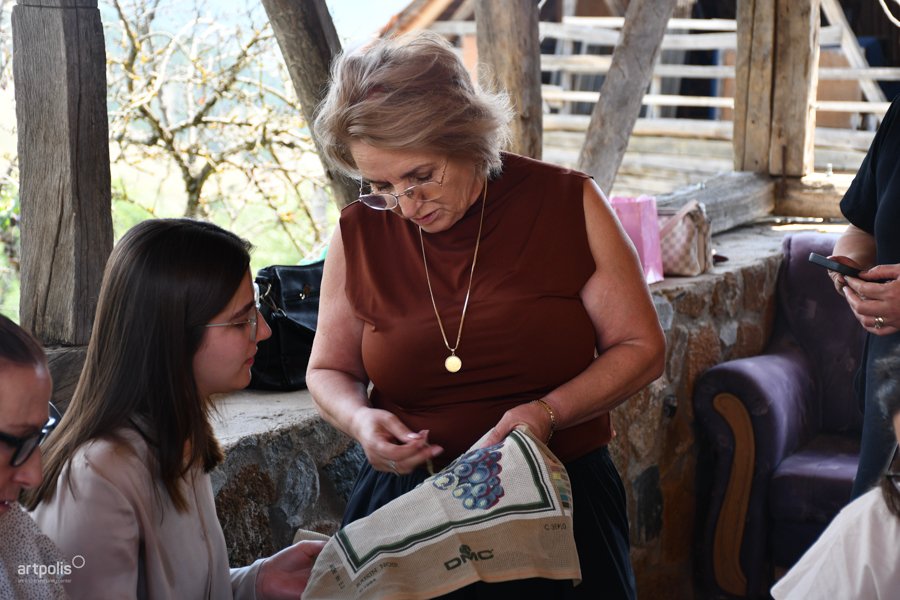
Workshops10.08.2026 On 10 August 2026, on the closing day of the 16th edition of Etno Fest in Kukaj Village, Artpolis, in cooperation with Etno Fest and QPDG, organized the workshop…
Read More
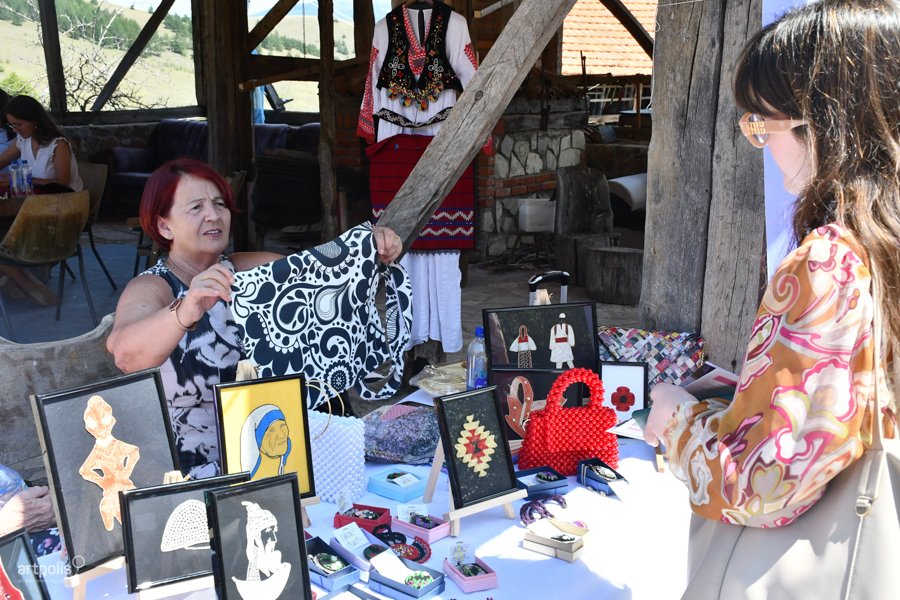
09-10.08.2026 On 9 and 10 August 2026, as part of the 16th edition of Etno Fest in Kukaj Village, the sales exhibition “Corner of Courage” was held, organized by Artpolis…
Read More